Children's Classic
Alice's Adventures in Wonderland
by Lewis Carroll
A dreamlike descent into a world where logic bends, language misbehaves, and growing up becomes the strangest adventure of all.
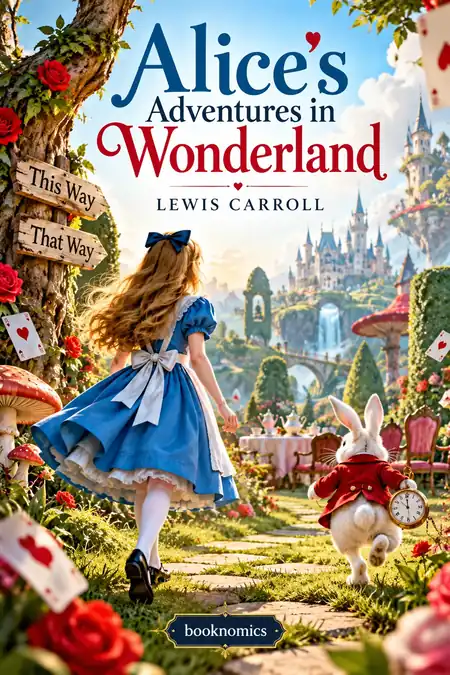
Alice's Adventures in Wonderland summary
Lewis Carroll’s Alice’s Adventures in Wonderland follows a curious child who tumbles down a rabbit hole into a world governed by unstable rules, verbal puzzles, abrupt transformations, and characters who constantly challenge ordinary assumptions. What begins as a chase after the White Rabbit becomes a sequence of encounters with the Caterpillar, Cheshire Cat, Mad Hatter, Queen of Hearts and others. Beneath the fantasy, the novel repeatedly examines identity, authority, language, childhood and the confusing expectations adults place on children. Its enduring power comes from the way nonsense exposes the hidden absurdities of supposedly sensible systems.
Key ideas
1. Identity is unstable during growth. Alice repeatedly changes size and questions who she is, turning physical transformation into a metaphor for childhood and self-discovery. 2. Language can create confusion as easily as clarity. Puns, riddles and literal interpretations show how words depend on context, convention and power. 3. Authority is often theatrical rather than rational. The Queen’s threats and the chaotic trial reveal institutions that demand obedience without earning legitimacy. 4. Curiosity drives learning. Alice’s willingness to ask questions moves the story forward, even when her questions irritate Wonderland’s inhabitants. 5. Rules are meaningful only when they are coherent and fair. Wonderland is full of rules, yet their inconsistency makes them absurd. 6. Childhood perception can expose adult contradictions. Alice frequently notices that the adults and authority figures around her behave more irrationally than she does.
Analysis
Why the novel still works Carroll does not simply create random fantasy. Wonderland repeatedly takes ordinary systems—school lessons, manners, law, games, conversation—and pushes them beyond coherence. The result is comic, but the comedy also reveals how much everyday life depends on shared conventions. When those conventions disappear, rules become arbitrary. Identity and transformation Alice’s changes in size reproduce a child’s experience of suddenly feeling too small, too large, too young or too responsible for a situation. Her repeated question about who she is becomes more than a puzzle. The book suggests that identity is tested through change. Alice does not discover one fixed definition of herself; instead she becomes more confident in her ability to reason and speak for herself. Language as a game of power Wonderland’s characters manipulate words constantly. They take metaphors literally, reverse meanings, interrupt definitions and use grammar as a weapon. These exchanges are funny because Alice expects language to function cooperatively while many characters use it competitively. The book therefore anticipates a modern insight: communication depends not only on vocabulary but on agreed rules, intentions and context. Authority without legitimacy The Queen of Hearts appears terrifying because everyone performs fear around her. Yet her commands are rarely carried out. H…
Practical application
Use Alice’s method of curiosity in one real situation today. When you encounter a rule, instruction or assumption that feels confusing, do not reject it immediately and do not obey it automatically. Ask: What is the purpose? What evidence supports it? Is the wording clear? Who is affected? Then rewrite the rule in plain language. The exercise trains the same skill Alice develops in Wonderland: separating genuine structure from confident nonsense.
Continue exploring
More English book summaries · Browse the full library · More Children's Classic books