Mathematics
Analysis of the Infinitely Small
by Guillaume de l'Hôpital
Analysis of the Infinitely Small — a clear guide to its mathematical ideas, methods, context, and limits.
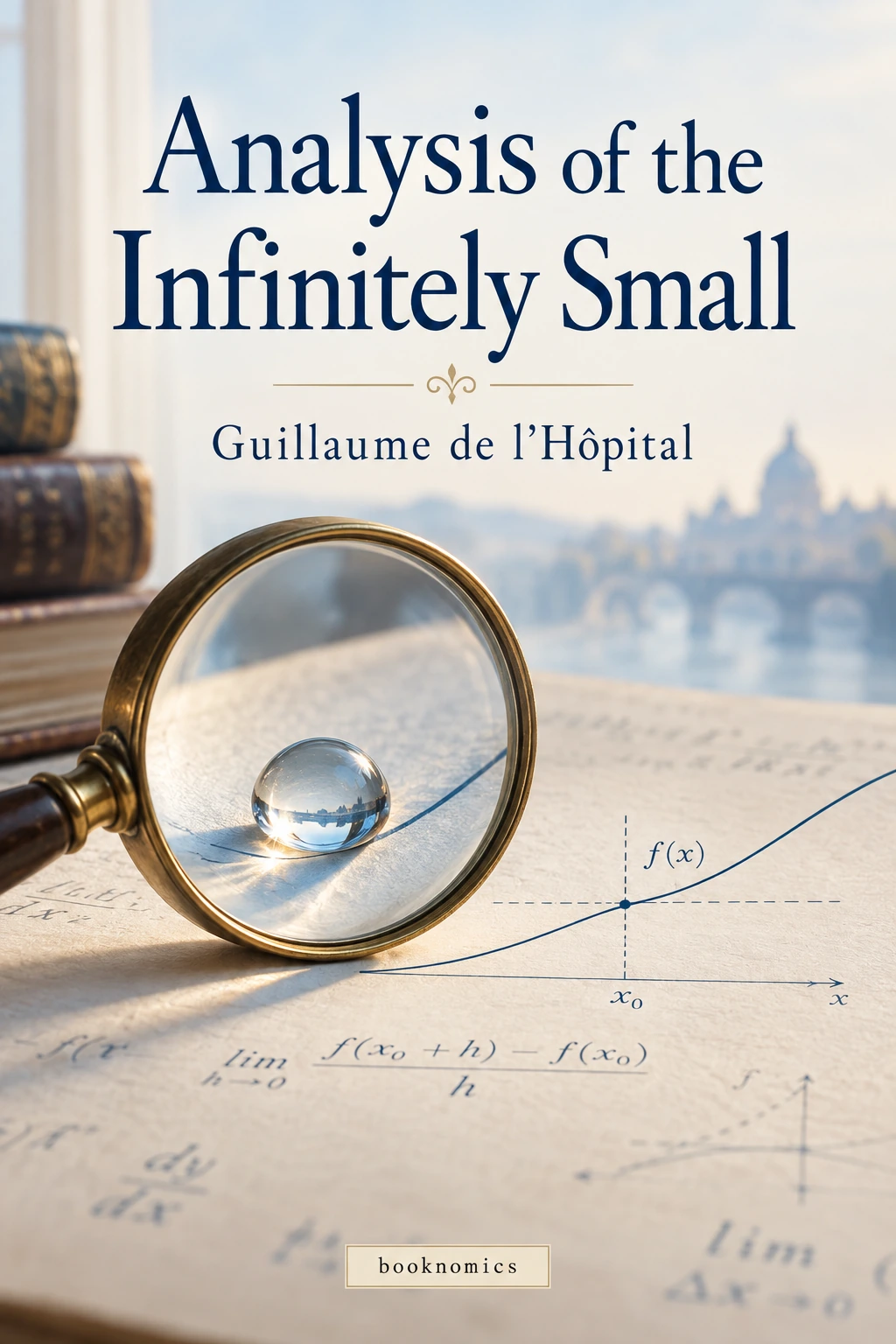
Analysis of the Infinitely Small summary
Analysis of the Infinitely Small by Guillaume de l'Hôpital is approached here as a mathematical work centered on early differential calculus, curves, extrema, tangents, and systematic presentation of infinitesimal methods. This Booknomics page does not reproduce a modern edition, translation, proof text, or exercise set. Instead it explains the architecture of the mathematics: what problems are being posed, what definitions make them precise, what methods organize the reasoning, and what later mathematics inherited from the work. Historical notation and standards of proof can differ sharply from modern practice, so the analysis separates the author's own framework from later reinterpretation.
Key ideas
problem setting. In Analysis of the Infinitely Small, problem setting helps reveal how mathematical meaning is built from definitions, operations, diagrams, algorithms, examples, and proof. The useful question is not only what result appears, but why the method works within the assumptions of the text. definitions and notation. In Analysis of the Infinitely Small, definitions and notation helps reveal how mathematical meaning is built from definitions, operations, diagrams, algorithms, examples, and proof. The useful question is not only what result appears, but why the method works within the assumptions of the text. core objects. In Analysis of the Infinitely Small, core objects helps reveal how mathematical meaning is built from definitions, operations, diagrams, algorithms, examples, and proof. The useful question is not only what result appears, but why the method works within the assumptions of the text. method of reasoning. In Analysis of the Infinitely Small, method of reasoning helps reveal how mathematical meaning is built from definitions, operations, diagrams, algorithms, examples, and proof. The useful question is not only what result appears, but why the method works within the assumptions of the text. worked structure. In Analysis of the Infinitely Small, worked structure helps reveal how mathematical meaning is built from definitions, operations, diagrams, algo…
Analysis
Deep analysis Analysis of the Infinitely Small matters because early differential calculus, curves, extrema, tangents, and systematic presentation of infinitesimal methods. Its significance is easier to see when the mathematics is separated into objects, representations, operations, and justification. Problem Setting In problem setting, Analysis of the Infinitely Small shows how mathematical thought depends on a carefully controlled language. Definitions determine what may be manipulated; notation or diagrams determine what can be seen; algorithms determine what can be calculated; and proof determines which conclusions survive beyond a single example. A second question is historical. The text should not be judged only by whether it matches a modern textbook. Its contribution may lie in creating a reusable representation, isolating a class of problems, making a procedure systematic, or raising the standard of demonstration. Later notation can make an old result look simple while hiding the conceptual work required to invent it. A third question concerns limits. Every mathematical presentation emphasizes some problems and suppresses others. problem setting should therefore be read together with the assumptions of the method, the kinds of quantities admitted, and the forms of argument available at the time. This keeps historical achievement distinct from modern reconstruction. De…
Practical application
5-minute reading lab 1. Start with Problem Setting. In one sentence, write what this section changes about your understanding of the book. 2. Put Problem Setting beside Definitions And Notation. Where do they reinforce each other, and where do they create tension? 3. Return to Core Objects and choose one example, argument, or piece of evidence already discussed in the analysis. Explain it in your own words. 4. Write one boundary question: what might this reading miss, or what would need stronger evidence? 5. Carry forward: finish this sentence with one concrete idea — “After reading Analysis of the Infinitely Small, I now notice differently.”
Continue exploring
More English book summaries · Browse the full library · More Mathematics books
- A Course of Pure Mathematics
G. H. Hardy
Mathematics - A Treatise on the Differential Calculus
Isaac Todhunter
Mathematics - A Treatise on the Integral Calculus
Isaac Todhunter
Mathematics - Almagest
Ptolemy
Mathematics - An Elementary Treatise on Quaternions
P. G. Tait
Mathematics - An Investigation of the Laws of Thought
George Boole
Mathematics