Entrepreneurship
Choose Your Enemies Wisely
by Patrick Bet-David, Greg Dinkin
An original Booknomics guide to the work’s structure, evidence, ideas, context, and limitations.
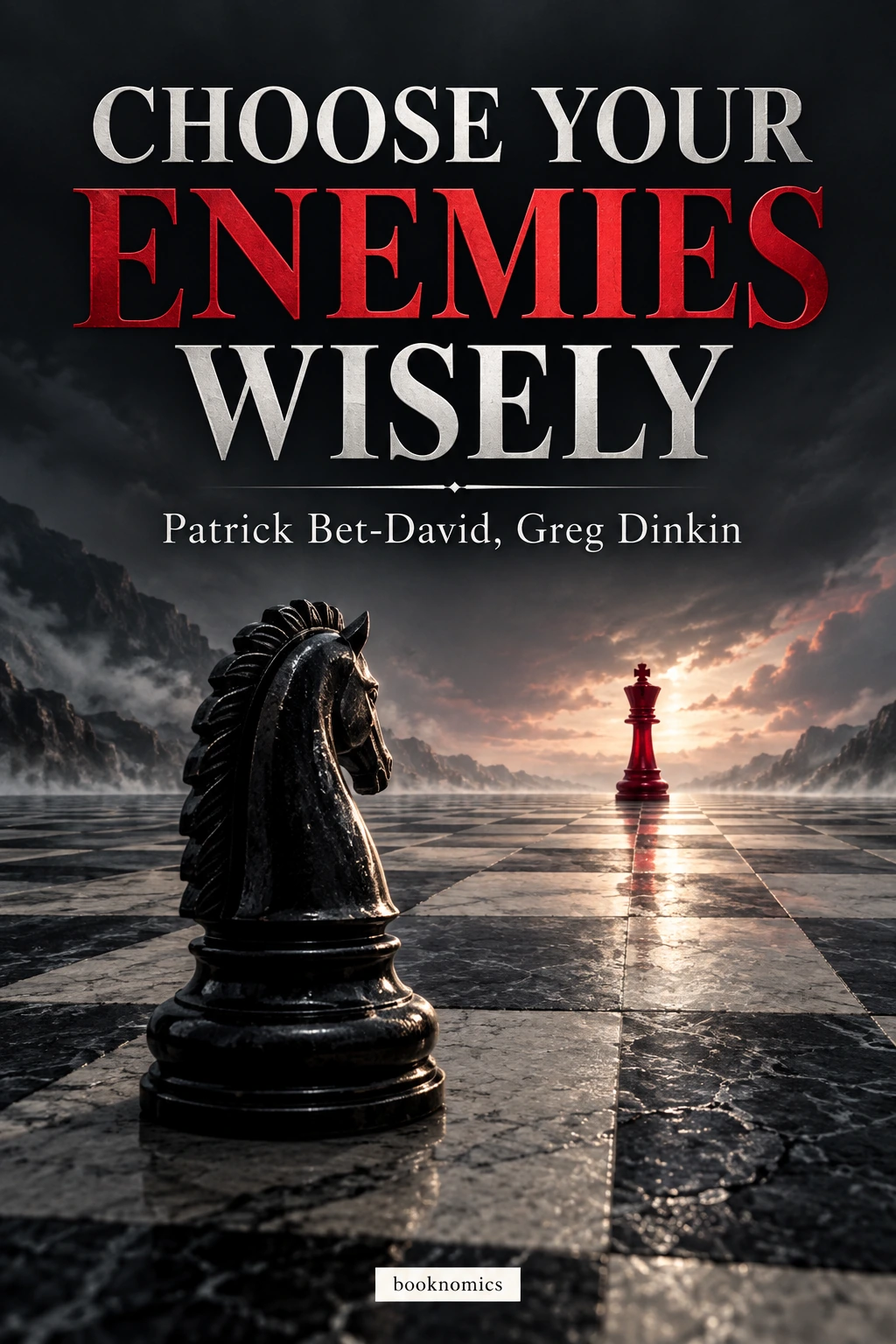
Choose Your Enemies Wisely summary
Choose Your Enemies Wisely by Patrick Bet-David, Greg Dinkin is approached here as a entrepreneurship work built around choices, systems, behavior, and results. Published in 2023, the analysis uses problem selection, customers, business model, experimentation, cash flow, and team as its main lenses. The useful task is not to copy recommendations mechanically, but to understand the mechanism behind them, define where they may apply, identify trade-offs, and test them with feedback. This Booknomics guide uses original explanatory prose and does not present anecdotes as universal proof or promise guaranteed outcomes.
Key ideas
problem selection. In Choose Your Enemies Wisely, this lens helps explain how the work develops its central problem. The useful questions are what the idea means here, what evidence or experience supports it, what changes when it becomes important, what trade-off it creates, and what limitation prevents it from becoming a universal rule. customers. In Choose Your Enemies Wisely, this lens helps explain how the work develops its central problem. The useful questions are what the idea means here, what evidence or experience supports it, what changes when it becomes important, what trade-off it creates, and what limitation prevents it from becoming a universal rule. business model. In Choose Your Enemies Wisely, this lens helps explain how the work develops its central problem. The useful questions are what the idea means here, what evidence or experience supports it, what changes when it becomes important, what trade-off it creates, and what limitation prevents it from becoming a universal rule. experimentation. In Choose Your Enemies Wisely, this lens helps explain how the work develops its central problem. The useful questions are what the idea means here, what evidence or experience supports it, what changes when it becomes important, what trade-off it creates, and what limitation prevents it from becoming a universal rule. cash flow. In Choose Your Enemies Wisely, this lens…
Analysis
Central reading Choose Your Enemies Wisely by Patrick Bet-David, Greg Dinkin can be examined through structure, evidence, practice, and consequence without reproducing the original text. The deeper questions concern what the work asks the reader to notice, what assumptions guide its reasoning, what feedback changes the picture, and where limits or uncertainty remain. 1. Problem Selection and Customers problem selection in Choose Your Enemies Wisely should be translated into an observable change. Define the current situation, identify the behavior, decision, process, or allocation the principle is meant to affect, and specify what evidence would count as improvement. This turns advice into a testable hypothesis rather than a promise. The connection with customers adds a trade-off test. A method that improves speed can reduce quality; growth can increase fragility; persuasion can reduce trust; leverage can amplify downside; measurement can change behavior. The reader should identify which cost is acceptable and which would invalidate the approach. Scale matters too. problem selection may work for one person, campaign, startup, portfolio, conversation, or organization but fail at another scale. A recommendation should not travel further than its assumptions permit. A good implementation therefore uses baseline, experiment, review, and revision. Results should be compared with exp…
Practical application
Practical or critical application 1. Define one real question related to problem selection. 2. Record the current baseline or interpretation. 3. Compare customers with business model. 4. Watch experimentation for side effects, counterevidence, or trade-offs. 5. Review the outcome through cash flow. 6. Decide whether team should change the next iteration. No outcome is guaranteed.
Continue exploring
More English book summaries · Browse the full library · More Entrepreneurship books
- Blitzscaling
Reid Hoffman and Chris Yeh
Entrepreneurship - Disciplined Entrepreneurship
Bill Aulet
Entrepreneurship - Entrepreneurship
Marc J. Dollinger
Entrepreneurship - Lean Analytics
Alistair Croll and Benjamin Yoskovitz
Entrepreneurship - One thousand ways to make $1000
Frances Mary Cowan Minaker
Entrepreneurship - Social Entrepreneurship
Arthur C. Brooks
Entrepreneurship