Classic Literature
Crime and Punishment
by Fyodor Dostoevsky
A brilliant but impoverished student murders a pawnbroker to test a theory about extraordinary people, only to discover that guilt, isolation, love, and conscience cannot be mastered by abstract logic.
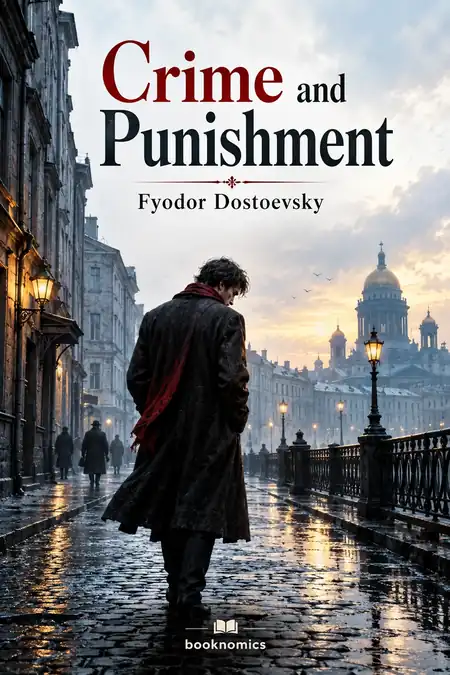
Crime and Punishment summary
Fyodor Dostoevsky’s “Crime and Punishment” follows Rodion Romanovich Raskolnikov, a former student living in extreme poverty in St. Petersburg. Alienated, proud, and obsessed with an idea that certain “extraordinary” individuals may step beyond ordinary moral law for a higher purpose, he decides to murder Alyona Ivanovna, an elderly pawnbroker he considers socially harmful. The crime immediately exceeds his theory: Alyona’s innocent half-sister Lizaveta unexpectedly enters, and Raskolnikov kills her too. Instead of becoming liberated, Raskolnikov falls into fever, fear, contradiction, and compulsive behavior. He is drawn toward the police investigation even while trying to evade it. Investigator Porfiry Petrovich suspects him and uses psychological pressure rather than simple evidence. At the same time, Raskolnikov becomes entangled with the suffering Marmeladov family, especially Sonya, who has entered prostitution to support her impoverished household. Sonya’s humility, endurance, and faith challenge his pride. Raskolnikov’s sister Dunya faces threats of a different kind. She breaks with the controlling Luzhin and later confronts Svidrigailov, a morally dangerous man from her past who tries to use knowledge of Raskolnikov’s secret to gain power over her. Dunya resists him; Svidrigailov eventually kills himself. Raskolnikov finally confesses the murder to Sonya, who urges him to accept responsibility. Porfiry also gives him an opportunity to confess voluntarily. He eventually goes to the police and admits the crime. Sentenced to penal servitude in Siberia, he remains emotionally proud for a long time, but Sonya follows him. In the epilogue, illness, separation, and Sonya’s steadfast presence begin a transformation that Dostoevsky deliberately presents as a beginning r…
Key ideas
Raskolnikov’s murder is fundamentally a test of whether he is “extraordinary,” not merely a robbery. Lizaveta’s unexpected death destroys the neat utilitarian logic he used to justify killing Alyona. Psychological punishment begins almost immediately, before legal punishment. Porfiry investigates through pressure, conversation, and understanding of Raskolnikov’s theory. Sonya represents suffering joined to compassion rather than pride. Razumikhin shows that poverty and intelligence do not inevitably lead to isolation or transgression. Dunya repeatedly demonstrates moral courage and refuses to become a tool of Luzhin or Svidrigailov. Svidrigailov acts as a dark double: transgression without Raskolnikov’s elaborate moral theory. Confession is necessary but does not instantly create repentance. The Siberian epilogue presents redemption as a difficult beginning, not a completed transformation.
Analysis
The novel’s deepest critique is directed at abstraction detached from relationship. Raskolnikov does not begin by wanting random violence. He constructs categories—useful and useless people, ordinary and extraordinary individuals—and then tests whether he can act according to those categories. The second murder reveals the danger immediately: real life introduces a person who was never part of the theory. Dostoevsky also separates punishment into several layers. The state eventually sentences Raskolnikov, but guilt has already reorganized his behavior. His fever, risk-taking, hostility, compulsive returns to the subject, and inability to use the stolen goods show that punishment can precede conviction. Sonya’s role is not to “solve” Raskolnikov through argument. She embodies a form of existence he has rejected: dependence, humility, sacrifice, and continued connection to others. Her power lies in refusing both his theory and his isolation. The epilogue is essential because it prevents the confession from becoming a mechanical moral ending. Raskolnikov can admit what he did before he fully understands why it was wrong. Dostoevsky insists that legal truth, intellectual truth, and transformed character do not arrive at the same moment. Theory collapses under human specificity Raskolnikov’s “extraordinary man” idea depends on abstraction. He imagines humanity divided into categori…
Practical application
Practical Application 1. Choose one idea: Select one key idea or theme from Crime and Punishment. 2. Find the evidence: Identify the argument, scene, pattern, or example in the summary/analysis that supports it. 3. Connect it to context: Write where the idea applies to your work, study, relationships, decisions, or reading—and where it may not. 4. Run a small test: Choose one concrete action, question, or observation for today. 5. Review the result: Note what changed, what did not, and one counter-example. The goal is not to memorize the book but to test its ideas thoughtfully.
Continue exploring
More English book summaries · Browse the full library · More Classic Literature books
- 1984
George Orwell
Classic Literature - A Christmas Carol
Charles Dickens
Classic Literature - A Connecticut Yankee in King Arthur's Court
Mark Twain
Classic Literature - A Farewell to Arms
Ernest Hemingway
Classic Literature - A Portrait of the Artist as a Young Man
James Joyce
Classic Literature - A Room with a View
E. M. Forster
Classic Literature