Classic Literature
Moby-Dick; or, The Whale
by Herman Melville
A restless sailor joins a whaling voyage and becomes trapped inside Captain Ahab’s obsessive hunt for the white whale Moby Dick—a pursuit that turns a commercial expedition into a tragedy of pride, fate, nature, and self-destruction.
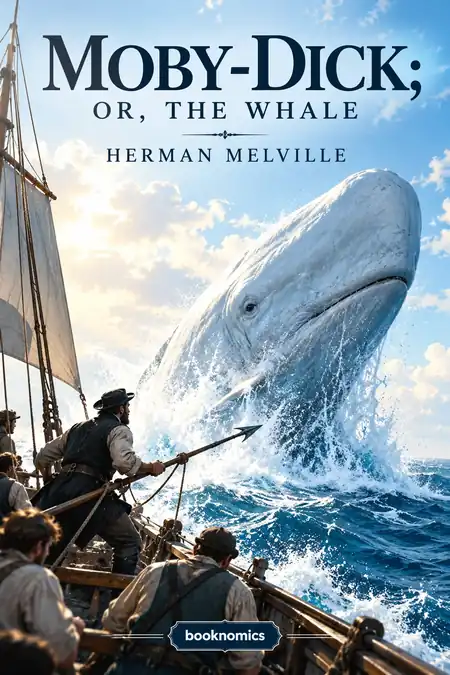
Moby-Dick; or, The Whale summary
Herman Melville’s “Moby-Dick; or, The Whale” follows Ishmael, a thoughtful wanderer who goes to sea to escape a dark mood and signs aboard the Nantucket whaling ship Pequod. Before sailing, he forms an unexpected friendship with Queequeg, a skilled Polynesian harpooner whose apparent “savagery” repeatedly exposes the prejudices of supposedly civilized society. The Pequod’s multinational crew initially seems bound for an ordinary sperm-whaling voyage, but Captain Ahab soon reveals his real purpose: he intends to hunt Moby Dick, the enormous white sperm whale that destroyed his previous boat and tore off his leg. Ahab converts a commercial voyage into a private war. He nails a gold doubloon to the mast as a reward for the first man to sight the whale and binds the crew to his vengeance. First mate Starbuck recognizes the madness and moral danger of Ahab’s mission, yet cannot stop him. As the ship crosses oceans, Melville interrupts the plot with meditations on whales, labor, race, religion, perception, storytelling, and the limits of human knowledge. Encounters with other ships repeatedly offer Ahab opportunities to turn away, including the Rachel, whose captain begs him to help search for a missing son. Ahab refuses. The final three-day chase ends catastrophically. Moby Dick destroys Ahab’s boats, kills or scatters crewmen, and finally sinks the Pequod. Ahab dies entangled in his own harpoon line. Ishmael alone survives, floating on Queequeg’s coffin, now transformed into a life-buoy, until the Rachel rescues him. The novel’s tragedy lies not in a whale behaving like a villain, but in a man insisting that the universe must answer his personal rage.
Key ideas
Obsession turns pain into a total worldview and destroys every competing value. Ishmael’s openness and capacity to revise his assumptions contrast with Ahab’s rigid certainty. Queequeg and Ishmael’s friendship challenges racial and cultural prejudice. The whale resists any single interpretation: animal, commodity, symbol, mystery, and projection. Starbuck represents conscience, restraint, and the difficulty of resisting destructive authority. The Pequod functions as a miniature, multinational human society bound together by risky labor. Melville treats knowledge as necessary but incomplete; classification never exhausts reality. Queequeg’s coffin becoming Ishmael’s life-buoy joins death and survival in one of the novel’s central paradoxes. Ahab repeatedly has chances to turn back, making his destruction tragic choice as much as fate. The Rachel’s rescue of Ishmael completes the moral contrast between human care and Ahab’s refusal to help.
Analysis
The deepest conflict in “Moby-Dick” is not man versus whale but human consciousness versus a world that may never explain itself. Ahab cannot accept contingency. Because his suffering feels intolerable, he assumes it must have an intentional source and turns Moby Dick into that source. His error is less that he hates a whale than that he mistakes interpretation for certainty. Ishmael offers the alternative. His long digressions are not failures of focus; they enact a plural method of knowing. He approaches whales through science, labor, art, myth, religion, economics, anatomy, humor, and personal experience. None is sufficient alone. The novel’s form therefore argues against Ahab’s monomania. Authority is another major theme. Ahab can transform a crew’s commercial contract into a suicidal private mission because charisma and hierarchy make resistance difficult. Starbuck sees the danger but cannot convert moral insight into effective opposition. Melville thus asks not only why destructive leaders become obsessed, but why competent people continue to serve them. The ending refuses sentimental consolation. Almost everyone dies. Yet Ishmael’s survival through Queequeg’s coffin suggests that human connection, contingency, and storytelling can preserve something even after catastrophic failure. The survivor cannot defeat the ocean; he can only bear witness. Knowledge, labor, and the…
Practical application
Practical Application 1. Choose one idea: Select one key idea or theme from Moby-Dick; or, The Whale. 2. Find the evidence: Identify the argument, scene, pattern, or example in the summary/analysis that supports it. 3. Connect it to context: Write where the idea applies to your work, study, relationships, decisions, or reading—and where it may not. 4. Run a small test: Choose one concrete action, question, or observation for today. 5. Review the result: Note what changed, what did not, and one counter-example. The goal is not to memorize the book but to test its ideas thoughtfully.
Continue exploring
More English book summaries · Browse the full library · More Classic Literature books
- 1984
George Orwell
Classic Literature - A Christmas Carol
Charles Dickens
Classic Literature - A Connecticut Yankee in King Arthur's Court
Mark Twain
Classic Literature - A Farewell to Arms
Ernest Hemingway
Classic Literature - A Portrait of the Artist as a Young Man
James Joyce
Classic Literature - A Room with a View
E. M. Forster
Classic Literature