Writing
On Writing Well
by William Zinsser
A guide to nonfiction writing emphasizing simplicity humanity structure revision voice audience and respect for words
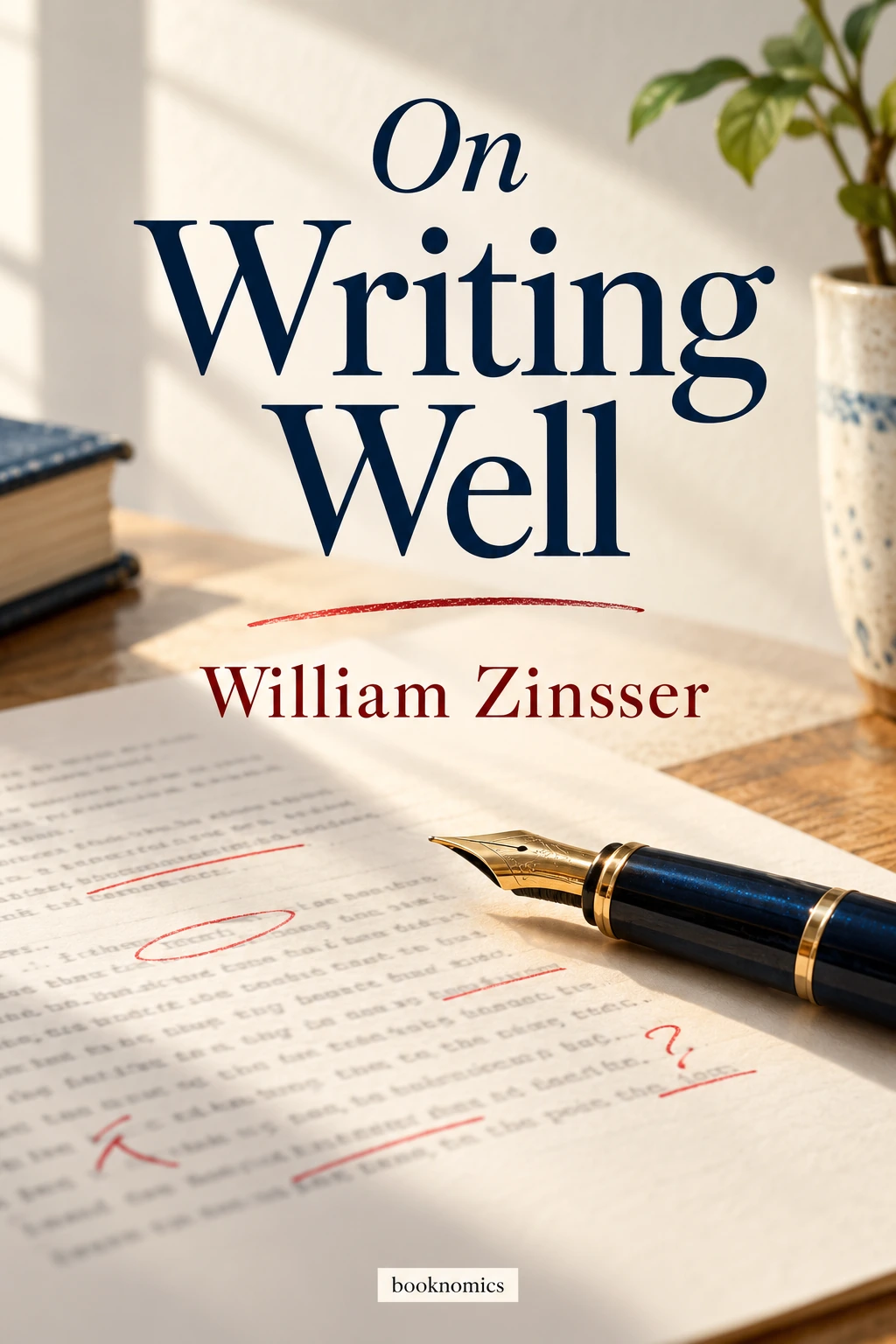
On Writing Well summary
On Writing Well by William Zinsser is a writing work centered on this problem: A guide to nonfiction writing emphasizing simplicity humanity structure revision voice audience and respect for words. Key anchors include Simplicity, Clutter, Style, The lead and ending. This Booknomics summary explains how those elements connect instead of treating them as isolated labels. It is written as original analysis rather than a reproduction of the book, and it avoids invented quotations, unsupported superlatives, and guaranteed-result claims. The reading separates the author's recommendation from evidence and implementation. Each principle is treated as a testable lens whose usefulness depends on constraints, incentives, timing, and feedback. The emphasis is on reader usefulness, specificity, and intellectual independence rather than keyword repetition or artificial certainty.
Key ideas
Simplicity. In On Writing Well, this idea helps organize the book's central problem. It should be read alongside Clutter because the two expose a relationship between motive, mechanism, evidence, consequence, or trade-off rather than a stand-alone slogan. Clutter. In On Writing Well, this idea helps organize the book's central problem. It should be read alongside Style because the two expose a relationship between motive, mechanism, evidence, consequence, or trade-off rather than a stand-alone slogan. Style. In On Writing Well, this idea helps organize the book's central problem. It should be read alongside The lead and ending because the two expose a relationship between motive, mechanism, evidence, consequence, or trade-off rather than a stand-alone slogan. The lead and ending. In On Writing Well, this idea helps organize the book's central problem. It should be read alongside Unity because the two expose a relationship between motive, mechanism, evidence, consequence, or trade-off rather than a stand-alone slogan. Unity. In On Writing Well, this idea helps organize the book's central problem. It should be read alongside Rewrite because the two expose a relationship between motive, mechanism, evidence, consequence, or trade-off rather than a stand-alone slogan. Rewrite. In On Writing Well, this idea helps organize the book's central problem. It should be read alongside Simpl…
Analysis
The book's central problem William Zinsser's work in On Writing Well can be approached through a specific central concern: A guide to nonfiction writing emphasizing simplicity humanity structure revision voice audience and respect for words. The goal of this analysis is to reconstruct the work's structure accurately enough to be useful while preserving uncertainty and avoiding copied prose. Recommendations are treated as mechanisms to examine rather than promises of guaranteed outcomes; examples are illustrative unless stronger evidence is part of the argument. 1. Simplicity Simplicity gives On Writing Well one of its strongest organizing lenses. The concept connects an immediate example, scene, claim, or practice to a larger pattern. That connection makes interpretation testable because the reader can ask where the pattern appears, what sustains it, and what changes when it is interrupted. For application, Simplicity has to become observable. Define a specific behavior, decision rule, customer response, management routine, or creative practice that would look different if the principle were genuinely being used. Then choose a small test before making a large commitment. Pair Simplicity with Clutter rather than optimizing it alone. Improving one variable can damage another: speed can reduce quality, control can reduce initiative, focus can create blind spots, and measurement c…
Practical application
Practical Application 1. Define one real situation where Simplicity appears. 2. Record a baseline before changing anything. 3. Use Clutter to design one small reversible change. 4. Watch Style and The lead and ending for trade-offs or side effects. 5. Review the result through Unity and decide whether Rewrite changes the next iteration.
Continue exploring
More English book summaries · Browse the full library · More Writing books
- A short guide to writing about biology
Jan A. Pechenik
Writing - Draft No. 4
John McPhee
Writing - Letters of note
Shaun Usher
Writing - Practical guide to writing
Sylvan Barnet, Marcia Stubbs, Pat Bellanca
Writing - Save the Cat!
Blake Snyder
Writing - Steering the Craft
Ursula K. Le Guin
Writing