Design
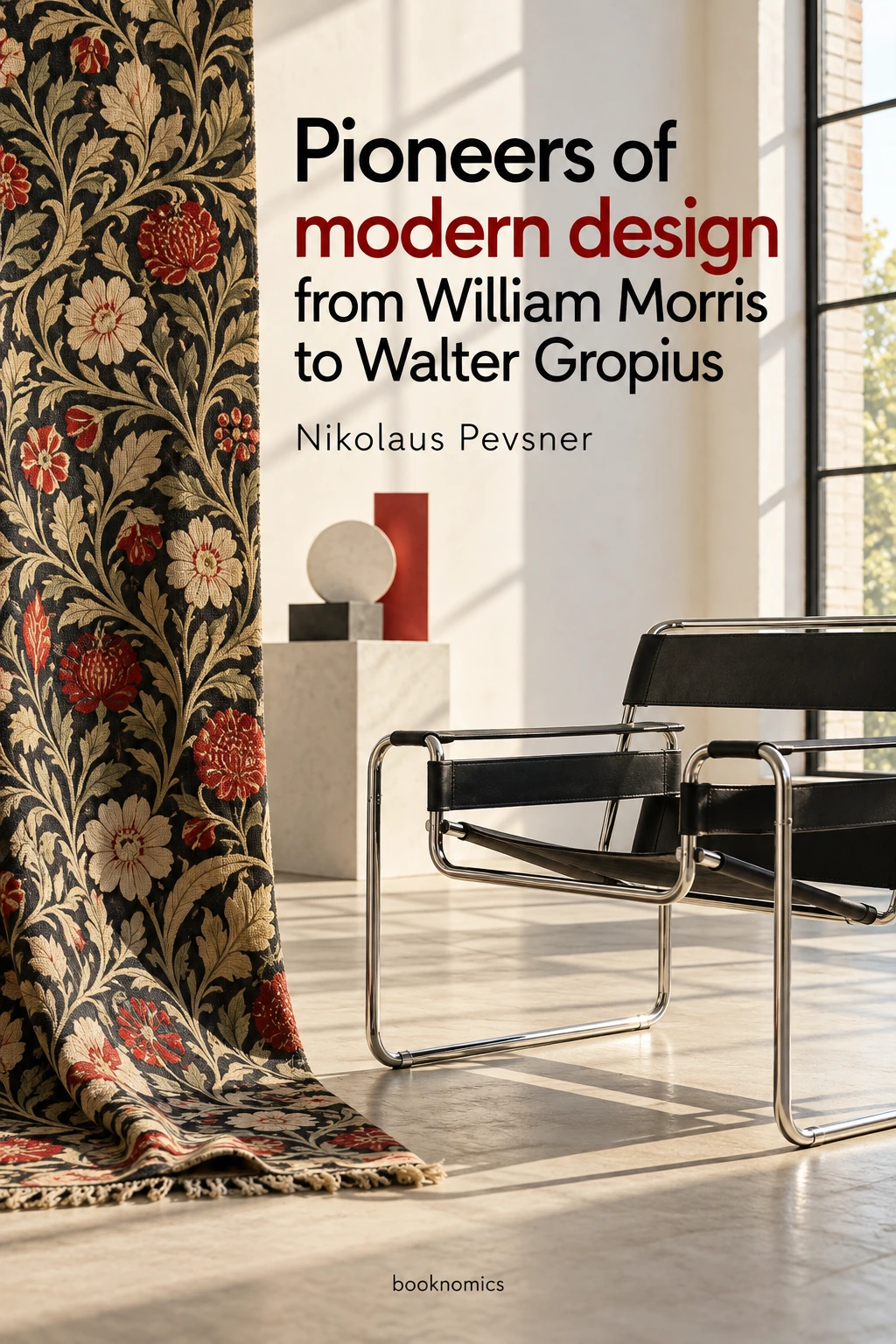
Pioneers of modern design from William Morris to Walter Gropius
by Nikolaus Pevsner
An original Booknomics guide to the work’s structure, evidence, ideas, context, and limitations.
Pioneers of modern design from William Morris to Walter Gropius summary
Pioneers of modern design from William Morris to Walter Gropius by Nikolaus Pevsner is approached here as a design work built around purpose, constraints, practice, feedback, and judgment. Published in 1949, the analysis uses function, users, constraints, form, iteration, and systems as its main lenses. The useful task is not to copy methods mechanically, but to understand what problem they solve, what conditions they assume, what trade-offs they create, and how results should be evaluated. This guide uses original explanatory prose and does not treat examples as guarantees.
Key ideas
function. In Pioneers of modern design from William Morris to Walter Gropius, this idea becomes useful only when translated into observable practice, a decision rule, a process, or a measurable result. The reader should ask what mechanism is implied, what context it assumes, what trade-off it creates, and what evidence would justify keeping or changing the approach. users. In Pioneers of modern design from William Morris to Walter Gropius, this idea becomes useful only when translated into observable practice, a decision rule, a process, or a measurable result. The reader should ask what mechanism is implied, what context it assumes, what trade-off it creates, and what evidence would justify keeping or changing the approach. constraints. In Pioneers of modern design from William Morris to Walter Gropius, this idea becomes useful only when translated into observable practice, a decision rule, a process, or a measurable result. The reader should ask what mechanism is implied, what context it assumes, what trade-off it creates, and what evidence would justify keeping or changing the approach. form. In Pioneers of modern design from William Morris to Walter Gropius, this idea becomes useful only when translated into observable practice, a decision rule, a process, or a measurable result. The reader should ask what mechanism is implied, what context it assumes, what trade-off it cr…
Analysis
Central reading Pioneers of modern design from William Morris to Walter Gropius by Nikolaus Pevsner can be examined as a practical framework rather than a collection of slogans. The useful questions concern purpose, mechanism, implementation, feedback, constraints, and side effects. The aim is to understand what the book recommends without treating examples as guarantees or assuming every method transfers unchanged to every reader or project. 1. Function and Users function in Pioneers of modern design from William Morris to Walter Gropius should be translated into an observable change. Define the current situation, identify the process or decision the principle is meant to affect, and specify what evidence would count as improvement. This turns advice into a testable hypothesis rather than a promise. The connection with users adds a trade-off test. A method that improves speed can reduce quality; stronger consistency can reduce flexibility; more expressive form can reduce clarity; measurement can change behavior. The reader should identify which cost is acceptable and which would invalidate the approach. Scale matters too. function may work for one page, object, draft, team, or project but fail at another scale. A recommendation should not travel further than its assumptions permit. A good implementation therefore uses baseline, experiment, review, and revision. Results should…
Practical application
Practical application 1. Define one real problem related to function. 2. Record a baseline. 3. Use users to design one small reversible change. 4. Watch constraints and form for side effects. 5. Review the outcome through iteration. 6. Decide whether systems should change the next iteration. No outcome is guaranteed.
Continue exploring
More English book summaries · Browse the full library · More Design books
- A guide to fashion sewing
Connie Amaden-Crawford
Design - Architecture
Clois E. Kicklighter, Joan C. Kicklighter, Ronald J. Baird
Design - Costume selection
Harriet Tilden McJimsey
Design - Don't Make Me Think
Steve Krug
Design - Dress pattern designing
Natalie Bray
Design - Inside fashion design
Sharon Lee Tate, Sharon L. Tate, Mona S. Edwards
Design