Political Thought
Propaganda
by Edward L. Bernays
A neutral Booknomics guide to the work’s historical context, claims, ideology, evidence, and consequences.
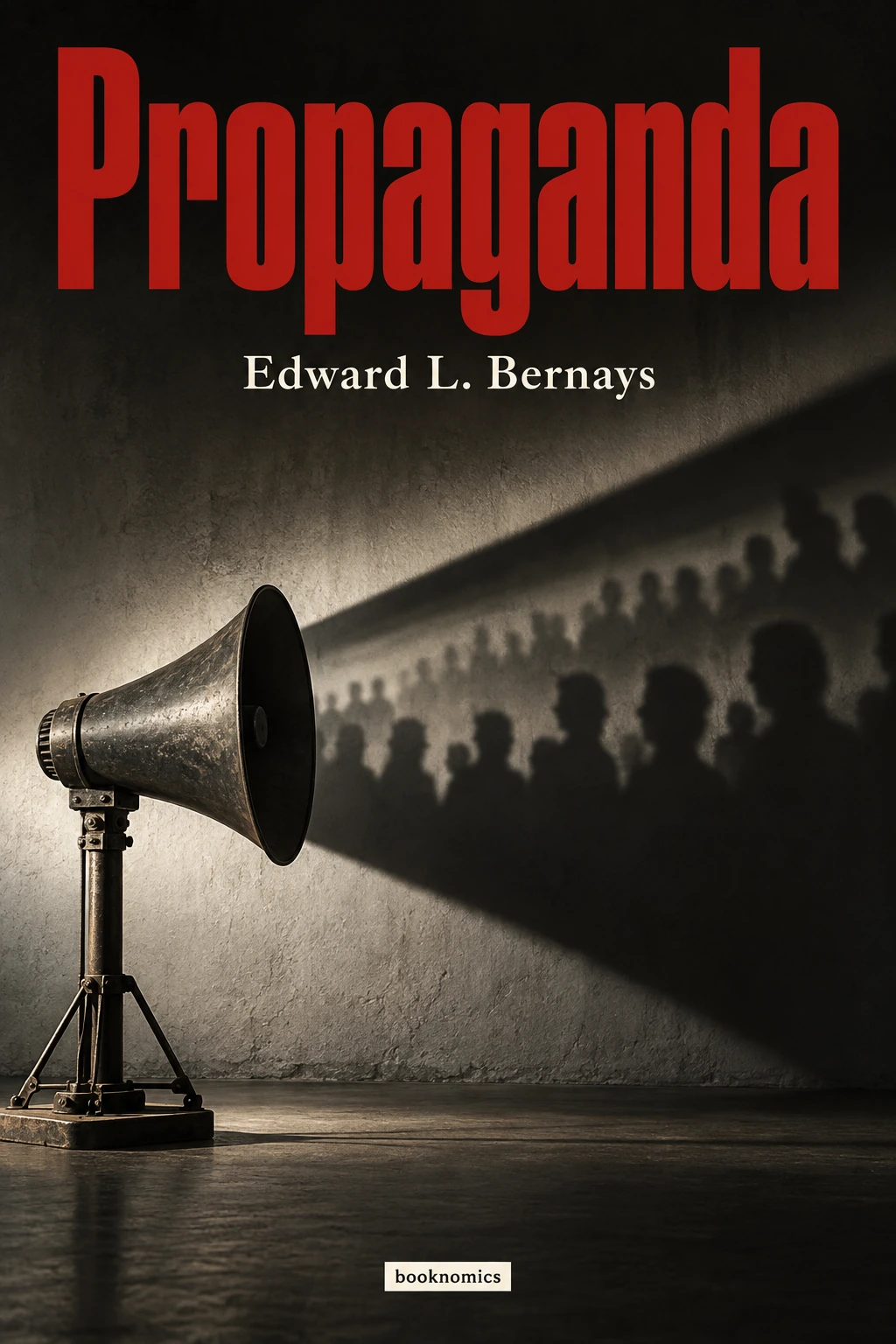
Propaganda summary
Propaganda by Edward L. Bernays is approached here as a political thought work organized around concepts, claims, evidence, and implications. Published in 1928, the analysis uses historical context, claims, ideology, institutions, power, and evidence as its main lenses. The goal is to reconstruct the work's intellectual architecture while keeping assumptions, counterarguments, uncertainty, and context visible. This page uses original explanatory prose and does not reproduce copyrighted passages or treat a summary as a substitute for the book.
Key ideas
historical context. In Propaganda, this lens helps explain how the work develops its central problem. The useful questions are what the idea means here, what evidence or experience supports it, what changes when it becomes important, what trade-off it creates, and what limitation prevents it from becoming a universal rule. claims. In Propaganda, this lens helps explain how the work develops its central problem. The useful questions are what the idea means here, what evidence or experience supports it, what changes when it becomes important, what trade-off it creates, and what limitation prevents it from becoming a universal rule. ideology. In Propaganda, this lens helps explain how the work develops its central problem. The useful questions are what the idea means here, what evidence or experience supports it, what changes when it becomes important, what trade-off it creates, and what limitation prevents it from becoming a universal rule. institutions. In Propaganda, this lens helps explain how the work develops its central problem. The useful questions are what the idea means here, what evidence or experience supports it, what changes when it becomes important, what trade-off it creates, and what limitation prevents it from becoming a universal rule. power. In Propaganda, this lens helps explain how the work develops its central problem. The useful questions are what the idea…
Analysis
Central reading Propaganda by Edward L. Bernays can be examined through structure, evidence, practice, and consequence without reproducing the original text. The deeper questions concern what the work asks the reader to notice, what assumptions guide its reasoning, what feedback changes the picture, and where limits or uncertainty remain. 1. Historical Context and Claims historical context is useful in Propaganda because it identifies one part of the work's explanatory structure. Start by defining the term precisely, then ask what kind of evidence supports it and whether the conclusion is descriptive, causal, interpretive, or normative. These claims require different kinds of support. The connection with claims creates an evidence test. What observation would support the mechanism, what alternative explanation could produce the same result, and what evidence would count against the claim. Scale matters as well. historical context may describe an individual, institution, market, technology, legal system, political system, or conceptual model. Moving across scales without additional evidence can make an argument appear stronger than it is. Context creates another boundary. Historical conditions, incentives, measurement choices, institutions, and selection effects can all change what the same observation means. Finally, compare historical context with claims and identify the unre…
Practical application
Practical or critical application 1. Define one real question related to historical context. 2. Record the current baseline or interpretation. 3. Compare claims with ideology. 4. Watch institutions for side effects, counterevidence, or trade-offs. 5. Review the outcome through power. 6. Decide whether evidence should change the next iteration. No outcome is guaranteed.
Continue exploring
More English book summaries · Browse the full library · More Political Thought books