History
Ten Days That Shook the World
by John Reed
An original Booknomics guide to the work’s structure, evidence, ideas, context, and limitations.
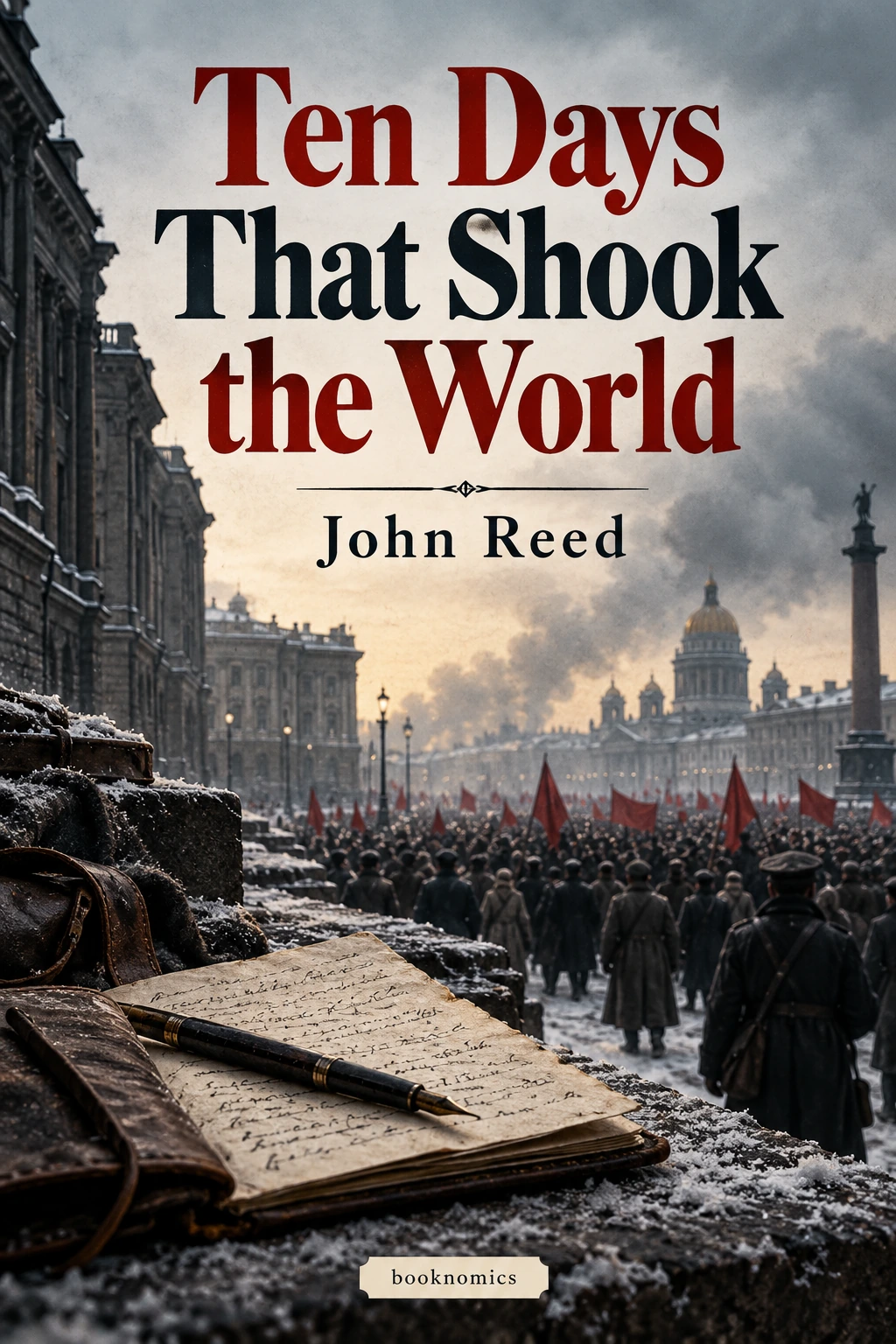
Ten Days That Shook the World summary
Ten Days That Shook the World by John Reed is approached here as a history work shaped by chronology, selection, perspective, evidence, and consequence. Published in 1919, the guide asks how the work organizes chronology, causation, institutions, evidence, contingency, and perspective, what kinds of evidence or memory support the account, and where hindsight may change interpretation. The aim is original explanatory analysis rather than copied prose or a substitute for the original work.
Key ideas
chronology. In Ten Days That Shook the World, this lens helps explain how the work develops its central problem. The useful questions are what the idea means here, what evidence or experience supports it, what changes when it becomes important, what trade-off it creates, and what limitation prevents it from becoming a universal rule. causation. In Ten Days That Shook the World, this lens helps explain how the work develops its central problem. The useful questions are what the idea means here, what evidence or experience supports it, what changes when it becomes important, what trade-off it creates, and what limitation prevents it from becoming a universal rule. institutions. In Ten Days That Shook the World, this lens helps explain how the work develops its central problem. The useful questions are what the idea means here, what evidence or experience supports it, what changes when it becomes important, what trade-off it creates, and what limitation prevents it from becoming a universal rule. evidence. In Ten Days That Shook the World, this lens helps explain how the work develops its central problem. The useful questions are what the idea means here, what evidence or experience supports it, what changes when it becomes important, what trade-off it creates, and what limitation prevents it from becoming a universal rule. contingency. In Ten Days That Shook the World, this lens…
Analysis
Central reading Ten Days That Shook the World by John Reed can be examined through structure, evidence, practice, and consequence without reproducing the original text. The deeper questions concern what the work asks the reader to notice, what assumptions guide its reasoning, what feedback changes the picture, and where limits or uncertainty remain. 1. Chronology and Causation chronology matters in Ten Days That Shook the World because narrative nonfiction is never only a container for facts. Selection, sequence, emphasis, and hindsight shape what the reader notices. A careful reading asks what evidence supports a scene or interpretation, what is reconstructed from memory, what comes from observation or public record, and what remains uncertain. A second question concerns scale. causation can look different at the level of an individual, family, institution, company, community, or historical period. Moving between scales prevents the account from turning a complex outcome into a single personality trait. The relationship between chronology and causation is especially useful. Personal choice operates inside constraints, while institutions and circumstances still leave room for agency. Hindsight is another boundary condition. Once outcomes are known, earlier moments can seem like obvious turning points. Ten Days That Shook the World is more illuminating when the reader preserves…
Practical application
Practical or critical application 1. Define one real question related to chronology. 2. Record the current baseline or interpretation. 3. Compare causation with institutions. 4. Watch evidence for side effects, counterevidence, or trade-offs. 5. Review the outcome through contingency. 6. Decide whether perspective should change the next iteration. No outcome is guaranteed.
Continue exploring
More English book summaries · Browse the full library · More History books
- Abraham Lincoln
Carl Sandburg
History - Freedom at Midnight
Dominique Lapierre, Larry Collins
History - The Enduring Vision
Paul S. Boyer
History - The Guns of August
Barbara W. Tuchman
History - The Right Stuff
Tom Wolfe
History - The Warmth of Other Suns
Isabel Wilkerson
History