Philosophy
The Daily Stoic
by Ryan Holiday and Stephen Hanselman
A year-long collection of Stoic passages and reflections organized around perception action and will designed for brief daily
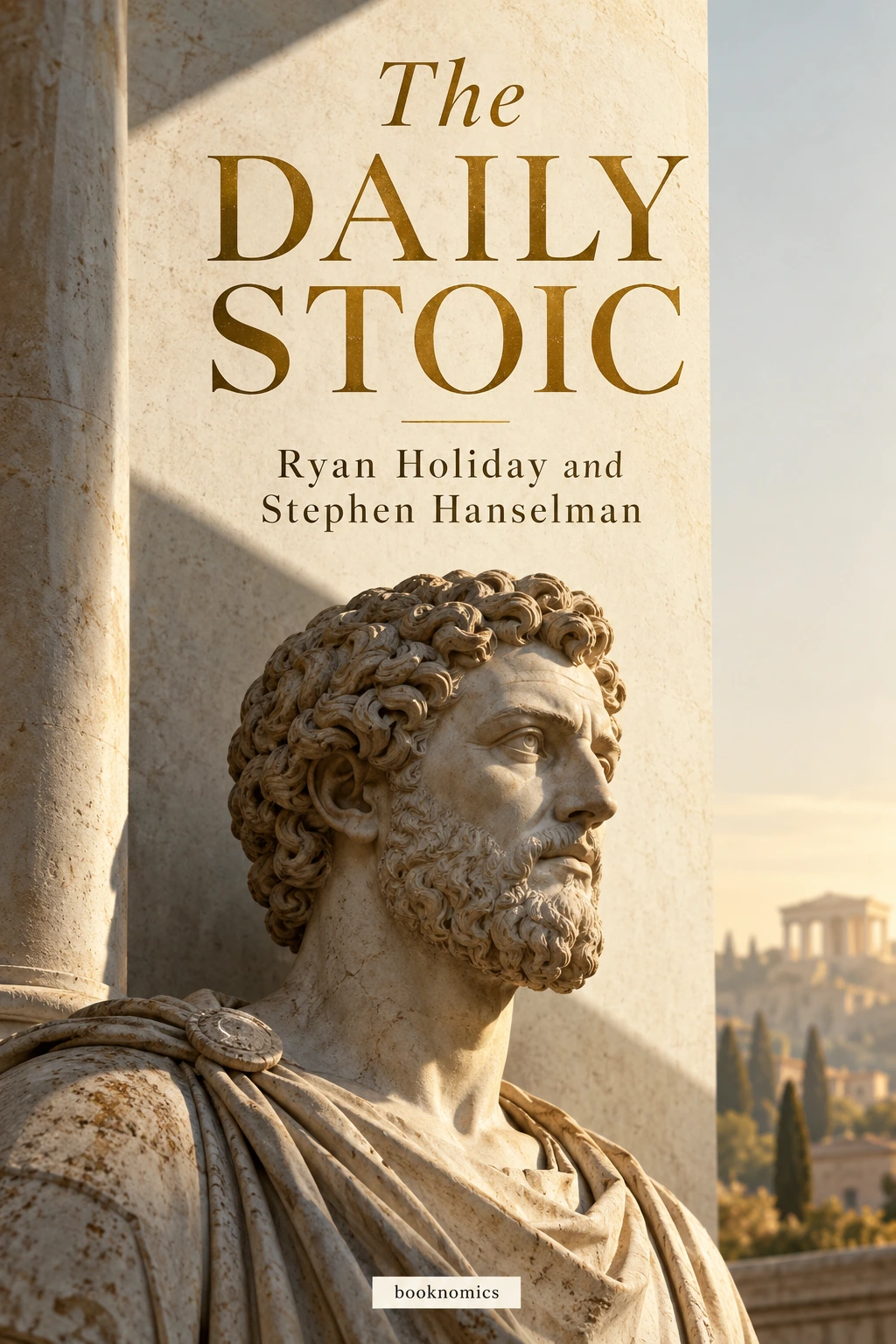
The Daily Stoic summary
The Daily Stoic by Ryan Holiday and Stephen Hanselman is a philosophy work centered on this problem: A year-long collection of Stoic passages and reflections organized around perception action and will designed for brief daily. Key anchors include Perception, Action, Will, Control. This Booknomics summary explains how those elements connect instead of treating them as isolated labels. It is written as original analysis rather than a reproduction of the book, and it avoids invented quotations, unsupported superlatives, and guaranteed-result claims. The reading separates definitions, descriptive claims, causal claims, interpretation, and broader implications. Historical or scientific examples are treated as context rather than automatic proof of every conclusion. The emphasis is on reader usefulness, specificity, and intellectual independence rather than keyword repetition or artificial certainty.
Key ideas
Perception. In The Daily Stoic, this idea helps organize the book's central problem. It should be read alongside Action because the two expose a relationship between motive, mechanism, evidence, consequence, or trade-off rather than a stand-alone slogan. Action. In The Daily Stoic, this idea helps organize the book's central problem. It should be read alongside Will because the two expose a relationship between motive, mechanism, evidence, consequence, or trade-off rather than a stand-alone slogan. Will. In The Daily Stoic, this idea helps organize the book's central problem. It should be read alongside Control because the two expose a relationship between motive, mechanism, evidence, consequence, or trade-off rather than a stand-alone slogan. Control. In The Daily Stoic, this idea helps organize the book's central problem. It should be read alongside Virtue because the two expose a relationship between motive, mechanism, evidence, consequence, or trade-off rather than a stand-alone slogan. Virtue. In The Daily Stoic, this idea helps organize the book's central problem. It should be read alongside Daily reflection because the two expose a relationship between motive, mechanism, evidence, consequence, or trade-off rather than a stand-alone slogan. Daily reflection. In The Daily Stoic, this idea helps organize the book's central problem. It should be read alongside Perception be…
Analysis
The book's central problem Ryan Holiday and Stephen Hanselman's work in The Daily Stoic can be approached through a specific central concern: A year-long collection of Stoic passages and reflections organized around perception action and will designed for brief daily. The goal of this analysis is to reconstruct the work's structure accurately enough to be useful while preserving uncertainty and avoiding copied prose. Definitions, description, causation, interpretation, and normative claims are kept distinct so the reader can see where the argument is strongest and where assumptions enter. 1. Perception Within The Daily Stoic, Perception is not an ornamental detail. It helps explain how the work moves from its central premise toward a more complicated understanding of motive, consequence, evidence, or meaning. Its value lies in the change of attention it creates: the reader notices variables that a simpler summary would miss. For an analytical reading, Perception should be separated into claim, evidence, and implication. What exactly is Ryan Holiday and Stephen Hanselman asserting, what kind of support is offered, and how far does the conclusion reasonably travel? This structure makes disagreement more precise and agreement less automatic. Compare Perception with Action. The comparison reveals whether the concepts reinforce one another, operate at different levels, or create an…
Practical application
Study & Reflection Application 1. Restate Perception in your own words. 2. Separate the claim around Action into description, explanation, and implication. 3. Connect Will with Control. 4. Write one boundary condition for Virtue. 5. Use Daily reflection to state one question the work clarifies and one it leaves open.
Continue exploring
More English book summaries · Browse the full library · More Philosophy books
- A History of Western Philosophy
Bertrand Russell
Philosophy - Bluets
Maggie Nelson
Philosophy - Civil Disobedience
Henry David Thoreau
Philosophy - Existentialism Is a Humanism
Jean-Paul Sartre
Philosophy - God Is Not Great
Christopher Hitchens
Philosophy - How to Be a Stoic
Massimo Pigliucci
Philosophy